

STAGE 1-2
ISOBARIC EVAPORATION OF THE WORKING FLUID Occurs when the pressure in the cylinder reaches the working pressure in the system.…
Our technology is an alternative to conventional and cost-uneffective heat conversion technologies. Due to lack of complex kinematics and multiple energy conversion steps, heat can be efficiently used to provide electricity production, direct pumping or compression.
The engine operates on a low-boiling point liquid which, due to evaporation in isobaric conditions increases its volume, causing the movement of the liquid piston. The hydraulic system convert the direct movement of the piston into useful work.
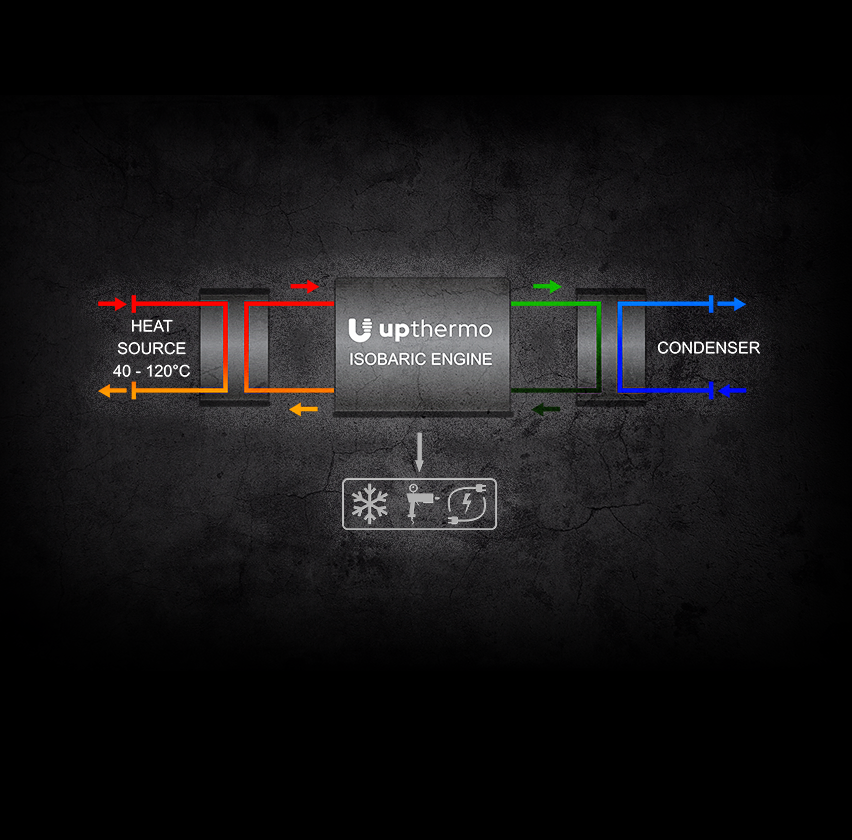
ORC technology is highly efficient, with typical conversion efficiencies of 7-18%. This means that more of the heat energy is converted into electricity, resulting in less waste heat. Organic fluids, such as hydrocarbons or refrigerants, have a higher thermal efficiency than water.
ORC systems can operate at lower temperatures than traditional Rankine cycle systems, which means they can recover heat from sources that would otherwise be discarded as waste. This is especially useful for industrial processes where low-grade waste heat is produced.
ORC technology can be scaled up or down depending on the needs of the project. It can be deployed as a standalone system or integrated with other power generation methods.
The working cycle consists of four successive thermodynamic transformations
The ORC systems are simple, requiring less equipment and less space than other power generation methods. The low maintenance and high reliability can also help to keep operating costs low.

STAGE 1-2
STAGE 2-3
STAGE 3-4
STAGE 4-1

Thermosiphon causes heat transfer through evaporation and condensation, which ensures high values of heat transfer coefficients and enables the use of a small heat exchange surface.
In order to reduce the friction as well as unreliable and defective sealing solutions, we use several working fluids in one working space.
Thanks to the use of off-the-shelf hydraulic components, the proposed technology is cheap and reliable.